After missing the sunset one night and only seeing its splendor over Instagram later in the evening, I dreamed up a digital photo frame that displayed the best moment of the sunset from the previous night. The frame would show the best moment of the sunset from the previous night, and after the current day's sunset finished, it would update for the next 24 hours with the most current sunset.
A few years and one computer science degree later, this project has come alive. Click below to see the latest sunset or keep reading to learn more about how I made this project come to life.
See the latest sunsetWith this project, I wanted to:
- Make something I thought was cool
- Build a full stack app and not overcomplicate the design
- Learn a few new tools / technologies
As someone new to the engineering world, this was an opportunity to go through full design and implementation. I look forward to hearing about improvements to the app!
I used some tools I have enjoyed learning (Svelte, AWS), added on a few new ones (TypeScript, Raspberry Pi, OpenCV), and got some more practice writing object-oriented code.
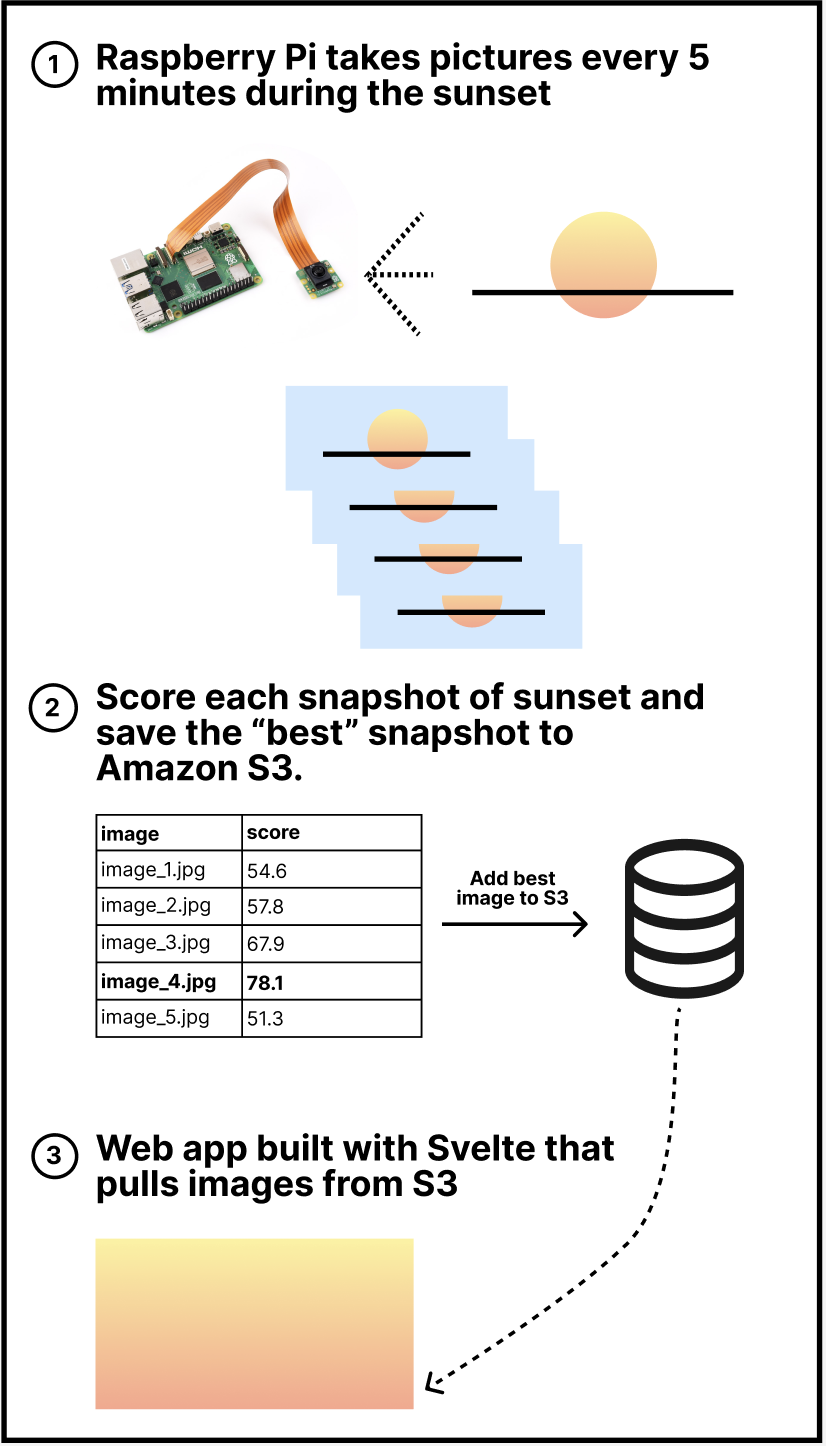
Using the Python package astral, I check what the time of sunset is and
schedule a Python script to run using the schedule package. The script takes a
picture using a Raspberry Pi every 5 minutes starting 40 minutes before sunset and continuing
for 10 minutes after sunset for a total of 12 images. I temporarily save these locally on the
SD card on the Raspberry Pi.
A short aside. Holy s*** was the Raspberry Pi a pain to get set up. A friend found one on the street and gave it to me so at least it was free. A short chronicle of my woes follows.
Start by trying to download the OS on a provided SD card. The Raspberry Pi OS is now 5GB but the old SD card it came with only is 4GB. Get new SD card. Load on the OS. Plug in Pi, try to SSH in, nothing happens. Plug into a monitor to see what's happening. Confirm everything is working (yay) but realize you need to log in the first time meaning you need a keyboard. Track down a USB keyboard to log in. Log in (yay). Try to connect to WiFi and realize you have an old Pi that does not have a built in WiFi adapter. Realize your kit includes one. Plug in and connect to WiFi (yay) for two minutes. However, then adapter gets too hot and stops working. Get new WiFi adapter. Connect to WiFi again (yay). Generate SSH key for GitHub and clone repo (yay). Try to get UV working. Realize Pi does not play nice with UV. Eventually give up and just use venv. Have issue with new version of Python Imaging Library (PIL) called pillow, which seems to be a known issue. Find fix. Finally get everything working and can run the full script (yay).
Using the Python packages Pillow (a fork of the no longer maintained original
Python Imaging Library PIL) and OpenCV, I compute a series of metrics, from
simply the average amount of red in every pixel to the percentage of pixels that fall
within color ranges for sunset hues. This is an area where a machine learning model could
possibly be helpful, but since I'm simply comparing the same scene over time in this
project, I believe this simpler approach yields acceptable results.
After an image is selected, the best image is uploaded to an S3 bucket along with some metadata and the rest of the files are removed from the Raspberry Pi to ensure there are no memory issues down the road. AWS permissions are the trickiest part of an otherwise simple process, but LLMs are quite good these days at explaining the process and creating the permission files needed.
This project lent itself to an object-oriented approach. I created a `SunsetDetector` class with adapters to modify the scoring and saving methods. Therefore, in the future if I want to explore new scoring methods or a different image storing platform, most of the code will stay the same and I will just have to change the underlying scoring and saving function used.
As someone who loves type hints in Python, this project was a good excuse to finally switch over to TypeScript from JavaScript. I also continued to build my experience with Svelte 5 and spent some extra time learning more about AWS S3 configurations and permissions.
Since the images are stored on S3, I can simply make the bucket public for read access (bots pls ignore), removing the need for a backend. Therefore, I can use a simple Svelte application to display the images and metadata. The Svelte app fetches the images from the S3 bucket and displays them on the page. I still have free credits from Heroku from a previous project, so I am hosting the Svelte app there.
There are two main areas for improvement:
- Explore better methods to determine the "best" sunset. While my simple scoring system works well, more sophisticated computer vision techniques or even a machine learning model trained on sunset aesthetics could improve selection quality.
- Find collaborators to run the pipeline in different cities and add their images to this workflow. This would create a network of sunset captures from across the world!
I don't consider myself primarily a data scientist, but I have enough experience to know that a more robust analysis of color distribution, cloud formations, and overall composition could yield better results than my current metrics.
However, this was primarily a passion project to keep me busy before starting a new job, and it works pretty well as is. Once I actually get a digital picture frame, there will be some additional work to figure out how to automate picture uploads and display rotations.
See the latest sunsetwant to stay up to date on my latest projects and blog posts?
That's all for now. Maybe I will do an update with an analysis once I get a month or two of photos. As always, all my projects are completely open source to check out the code if you are interested. Thanks for reading!